The connection between Kalaripayattu and Kalari Chikitsa
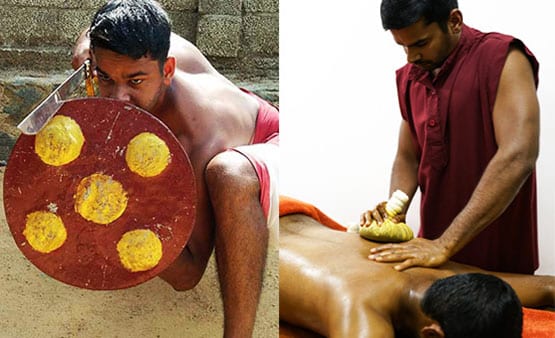
The warrior-healer tradition
Kalaripayattu is Kerala’s traditional martial art, and Kalari Chikitsa is its healing system. In ancient Kerala, a warrior was also a healer, able to treat the injuries of training and of battle.
The relationship between martial and healing practices may seem contradictory. Yet within this tradition, each complements and supports the other.
This tradition continues in Kerala today, where traditional kalari schools provide both martial training and healing treatments. The Kalaripayattu master (Gurukkal) plays the dual role of martial arts teacher and healer.
Master Biju Nair continues this warrior-healer tradition at our centre in Brisbane, Australia. The connection can be seen in how he moves between teaching Kalaripayattu and treating patients with Kalari Chikitsa, and in how our students experience both sides of the tradition.
Our Kalari community

- Kalari students help make the massage oils and balms used in treatment.
- Some students and patients grow the plants used to make these oils and balms.
- Some students and patients help care for our herbal gardens.
- Long-term patients attend our student performances and cultural functions.
- Students receive massage to support and enhance their kalari practice.
- Patients and their family members sometimes become kalari students.
- Students’ families and friends, in turn, sometimes become patients.
Learning within the tradition
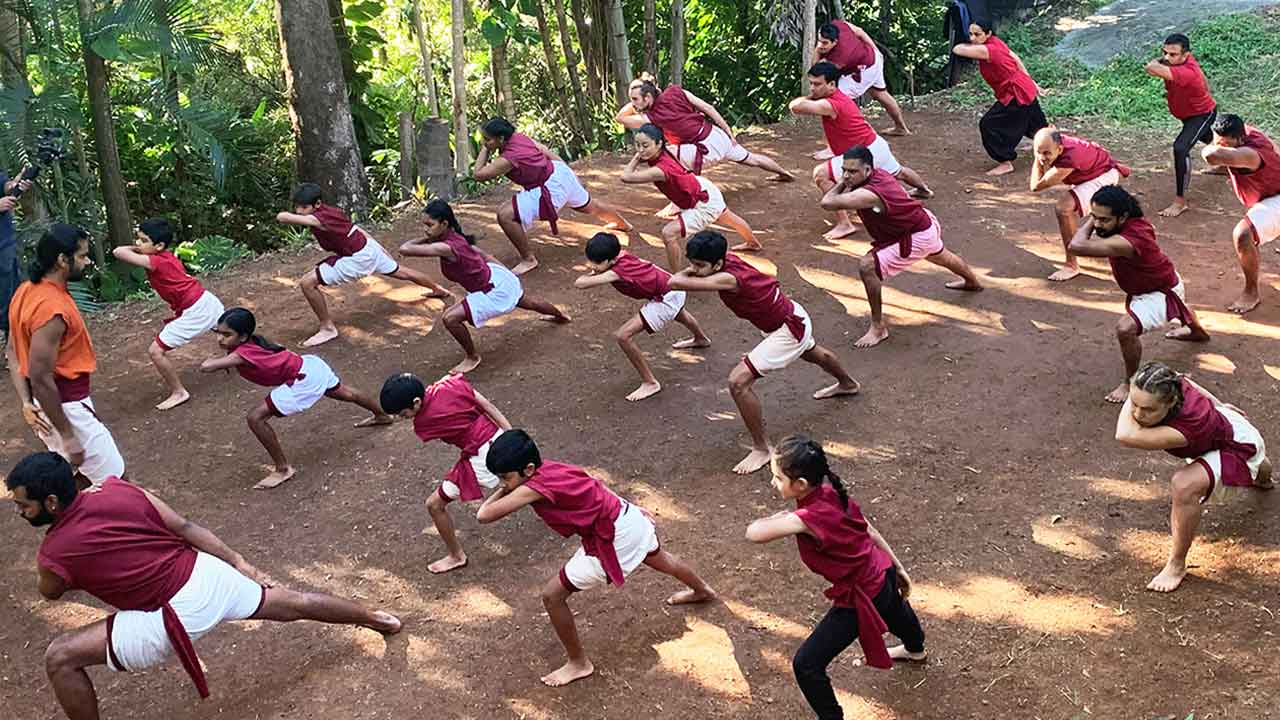
Kalaripayattu stages include:
- Body conditioning training (Meithari)
- Wooden weapons training (Kolthari)
- Metal weapons training (Angathari)
- Empty-hand techniques, including Marma applications for attack and defence (Verumkai and Marma vidya)

Kalari Chikitsa stages include:
- Medicine making (Marunnu undakkal)
- Massage with the hands (Kai uzhichil)
- Massage with kizhi (Kizhithirummu)
- Massage with the feet (Chavitti uzhichil)
- Marma applications for healing (Marma chikitsa)
A student advances through Kalaripayattu for years before training in Kalari Chikitsa is gradually added alongside it. Progress in one supports progress in the other. Marma, the most guarded knowledge in both arts, comes last in each and is taught only once a student has shown mastery in everything that came before.
The relationship between martial and healing knowledge is therefore experienced directly, over years. As with any traditional Indian art form, gaining this knowledge is a long and rigorous process of practice rather than simply learning a set of techniques.
The martial art informs the healing art, and vice versa

Kalaripayattu prepares the student for the healing art, just as Kalari Chikitsa prepares the student for the martial art.
Through years of body conditioning, footwork, weapons practice and empty-hand techniques in Kalaripayattu, the student develops the strength, balance, timing, rhythm, dexterity and control required for the healing art:
- Years of footwork (chavudus) translate into the control needed for massage given with the feet.
- Weapons practice builds the grip strength used for grinding and preparing herbs, the steady control used in massage and the precision needed to locate marma during treatment.
- Just as the movements of an experienced martial artist are graceful, powerful, rhythmic and fluid, the same qualities are sought when performing the massage.
- Years of watching how students move, and where their movement is restricted, develop the same eye that later recognises an injury on the treatment table.
Kalari Chikitsa, in turn, looks after the Kalaripayattu student in three ways: preparing the body for training, supporting it through training and helping it recover afterwards.
Learning the healing art also contributes directly to their Kalaripayattu training:
- Medicine making develops patience, concentration and attention to detail, while hours spent grinding and preparing herbs strengthen the hands and arms used in weapons practice.
- Giving treatment develops the student’s understanding of injury, restriction and recovery, knowledge that feeds back into their own training.
- Receiving massage and other treatments gives the student first-hand experience of how their own body can be conditioned, restored and prepared to move again.
Marma knowledge in both arts

Marma are vital regions of the body, located where different tissues and structures meet.
For Kerala’s warriors, knowledge of marma was used for both battle and healing. Their lives could depend on knowing how to attack a marma to stun or disable an opponent, protect their own marma and treat an injury to one.
In this tradition, one must understand how a marma can be harmed to understand how it can be healed through a counter-application. A Kalaripayattu master knows exactly where the marma are located, how to affect them in fighting, how to identify them when injured and how to treat them for healing.
Keeping the tradition alive
Kalaripayattu trains the body. Kalari Chikitsa cares for the body that has been trained. Each preserves and deepens the other.
Keeping these arts together allows the knowledge of movement, weapons, medicine, treatment and marma to be passed on as one tradition. It also preserves the Gurukkal’s role as both martial teacher and healer.
Here, Kalaripayattu and Kalari Chikitsa continue to be taught and practised side by side.
More about Kalaripayattu and Kalari chikitsa

Kalaripayattu training
Kalaripayattu is the traditional martial art of Kerala. Master Biju Nair teaches at our school, Australian School of Kalaripayattu. Kalaripayattu develops the body and mind through a powerful flowing practice. It is a comprehensive system that was originally designed to create an expert warrior.

What is Kalari chikitsa?
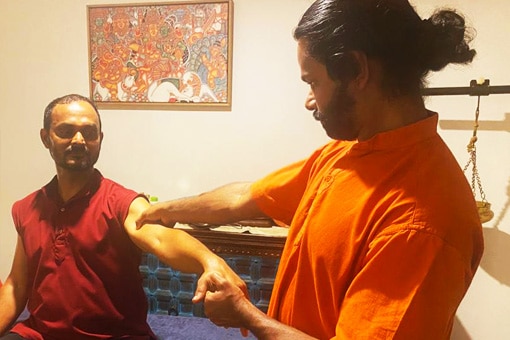
Marma therapy
Marma applications are an important part of our Kalari treatments for injuries and pain-related conditions. Our method of marma applications comes from Kerala’s Kalaripayattu tradition.
- 0424 939 130
- Book online
- 30-32 Nandala Drive, Tanah Merah, Queensland
- info@kalariayurveda.com.au